
CITIZEN DEVELOPER GUIDE
This website is a guide and is not intended to replace professional advice. Please see our disclaimer for more information!
Consultation
City of Ottawa
Zoning Visualization
New zoning regulations are often confusing for the community to understand, but they don’t have to be.


Client:
City of Ottawa
City of Ottawa
Date:
2025
2025
Team:
Samantha Eby
Toby Evans
Michael Piper
Irina Rouby Apelbaum
Samantha Eby
Toby Evans
Michael Piper
Irina Rouby Apelbaum

Project Goals
While in the process of updating its Zoning By-law to make it more efficient, effective, and responsive to the city’s current and future needs, the City of Ottawa wanted to develop a set of accompanying visuals that could serve both as a resource for community consultation and as a test of how the proposed zoning rules might be interpreted by architects and designers.
The goal of this visualization project was to produce drawings that are accessible and easy to understand for non-professionals, while accurately representing the proposed Zoning By-law provisions.
Zones and Subzones
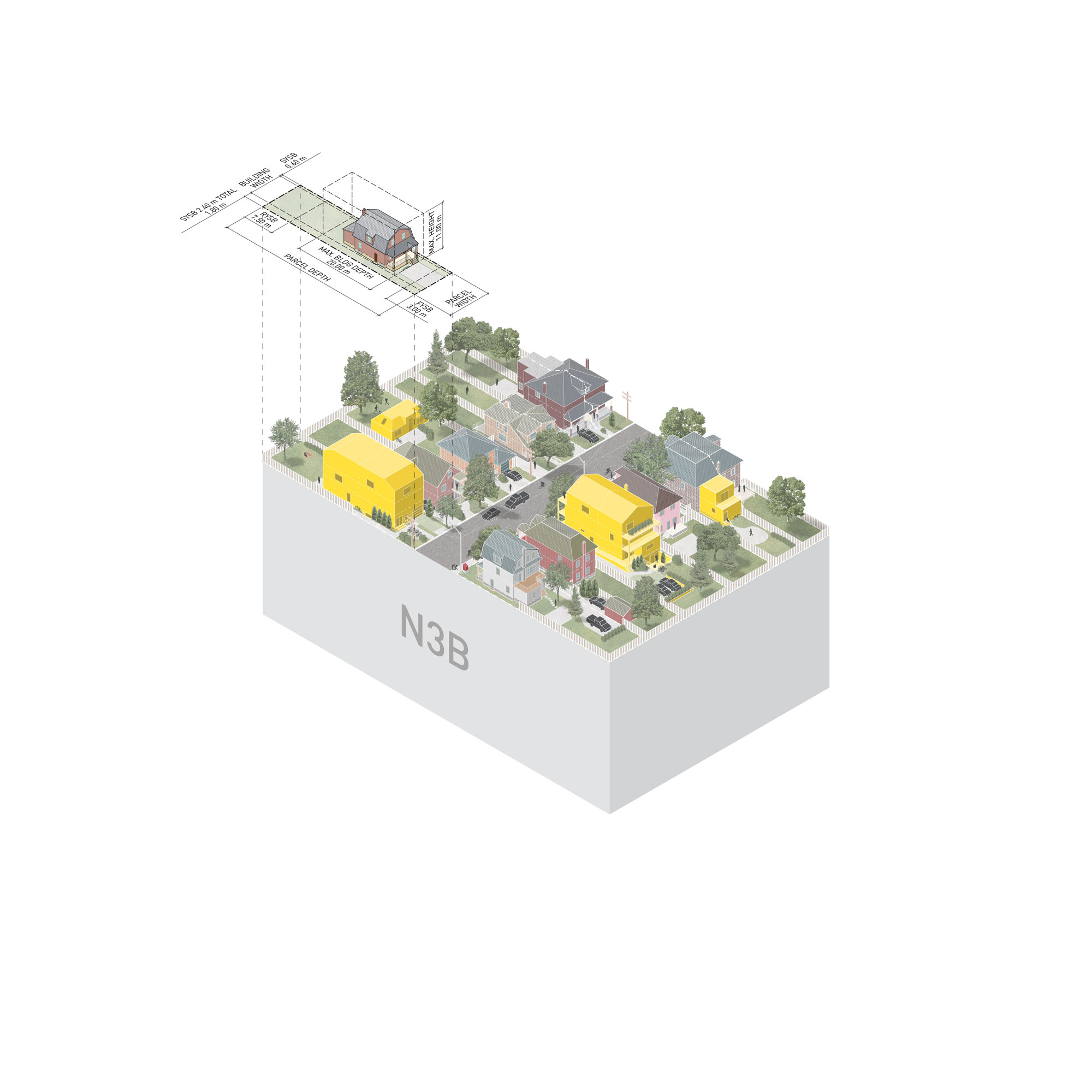
In the New Zoning By-law, current Residential zones (R1-R5) are replaced with a new N - Neighbourhood Zone structure. These zones are linked to the urban context and transit networks, and they regulate density and maximum building heights.
N1 and N2 correspond to low-density residential areas, N3 and N4 correspond to areas near corridors or community nodes allowing mid-scale development, and N5 and N6 correspond to higher-density areas near major transit hubs.
The Neighbourhood Subzones (A-F) regulate elements of “residential character” such as lot width and yard setbacks.
Together, these regulations combine to allow different levels of gentle density. Our block-scale axonometrics tested the building envelopes produced by the Neighbourhood Zones and Subzones rules on N1, N2, N3 and N4 Zones.




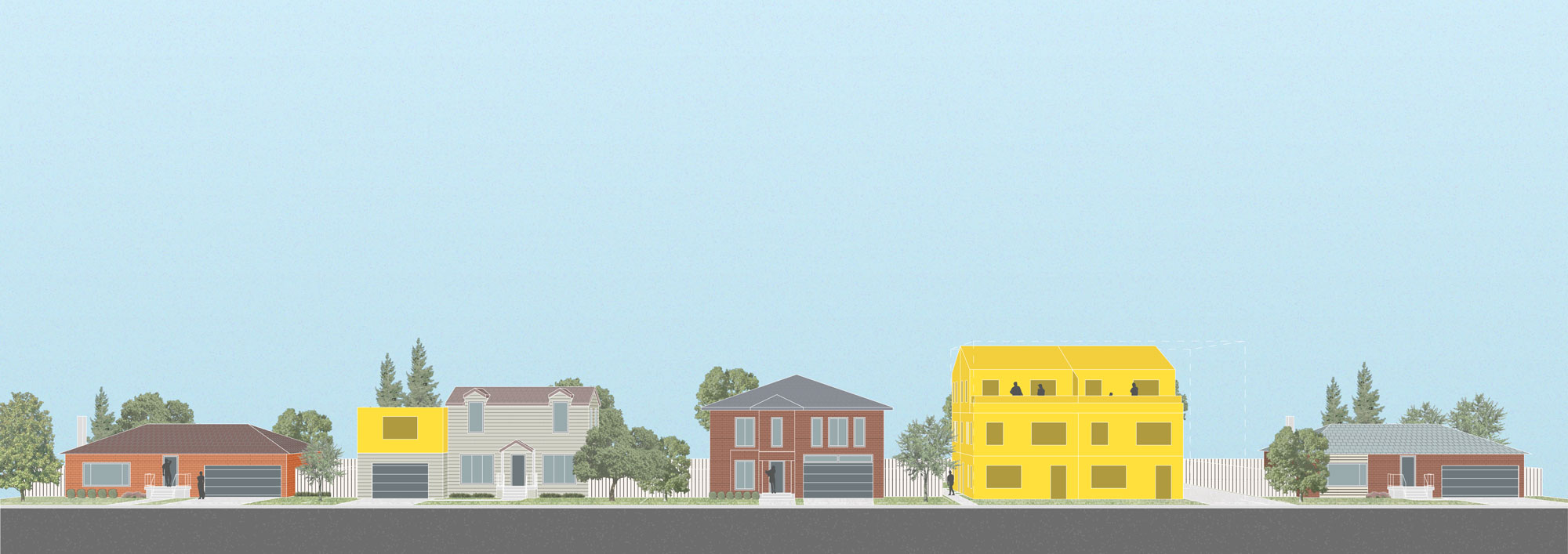
From the Street
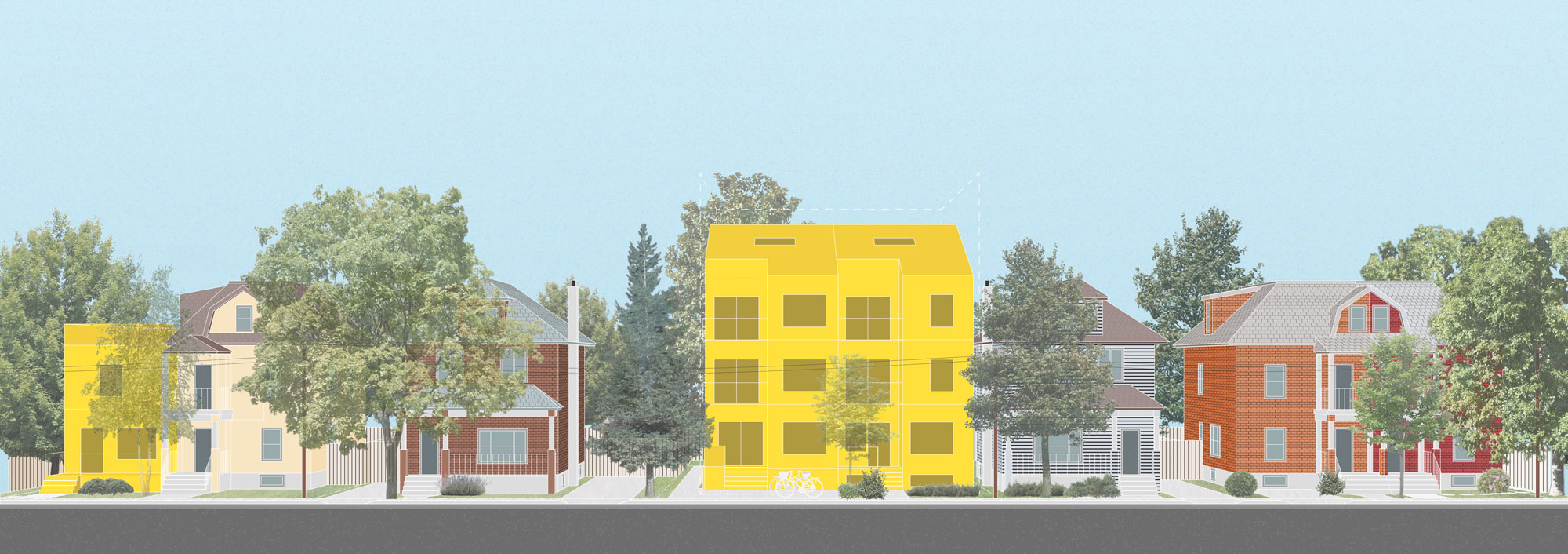
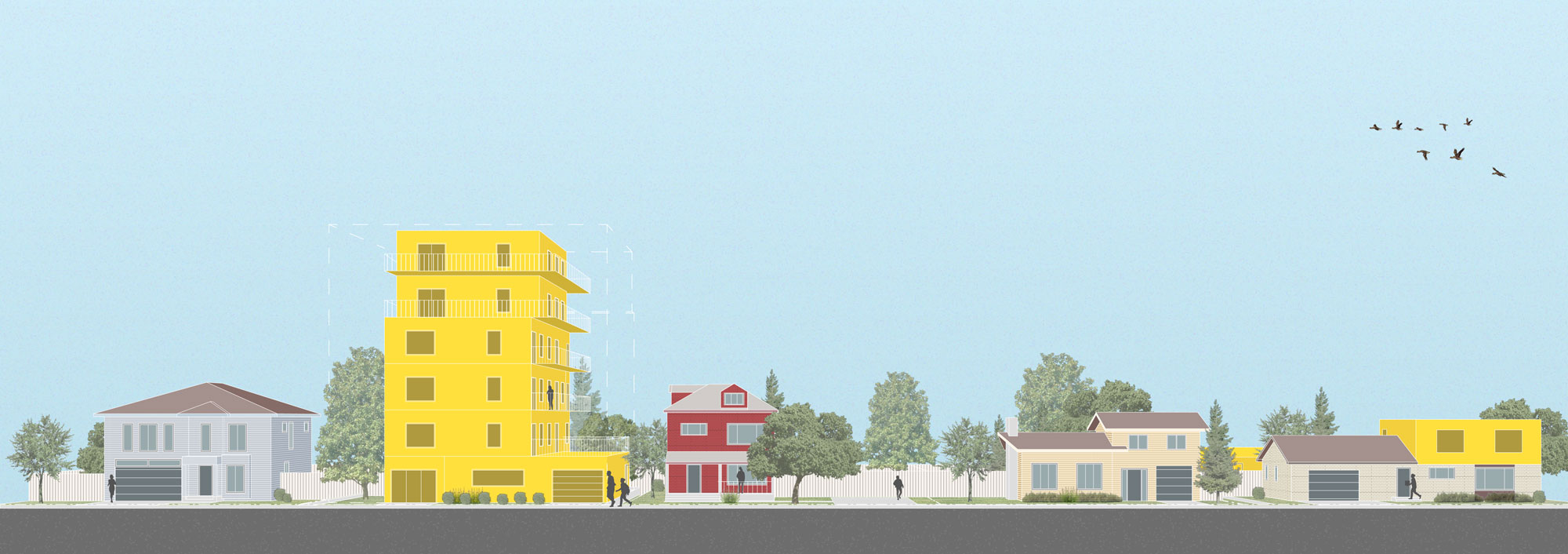
A key tool to communicate the impacts of new zoning is to look at the results of this zoning from a pedestrian’s perspective. These drawings show the extent of new development expected in neighbourhoods and demystifies notions of increased density being detrimental to neighbourhood character and the quality of its spaces.The Neighbourhood as a Whole
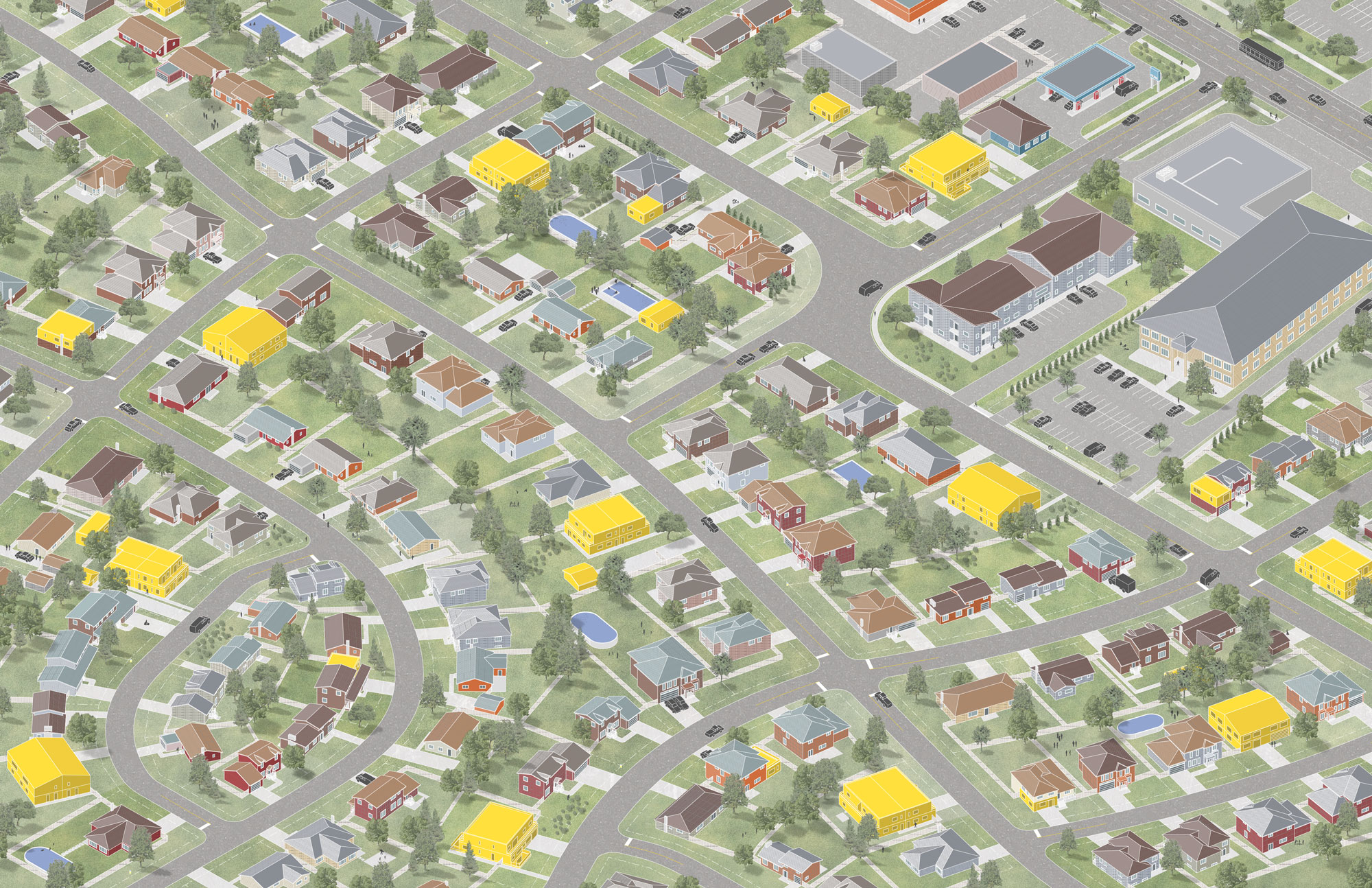
Finally, the building massings developed through the block-scale axos and elevations were shown at a broader neighbourhood scale. The before and after neighbourhood axonometrics show the intensity and extent of gentle density development expected within 20 years for the Inner Urban, Outer Urban, and Suburban Transects of Ottawa. Developments in the Neighbourhood Zone are shown in yellow, while developments in Minor Corridor Zones are shown in purple.

Inner Urban

Outer Urban

Suburban
Inner Urban
Outer Urban
Suburban
THIS WEBSITE, INCLUDING ALL DATA AND INFORMATION INCORPORATED HEREIN, IS BEING PROVIDED FOR INFORMATION PURPOSES ONLY AND IS NOT INTENDED FOR AND HAS NOT BEEN APPROVED FOR USE FOR CONSTRUCTION AT ANY LOCATION.
For certainty, ReHousing (Canada), The University of Toronto, John H. Daniels Faculty of Architecture Landscape and Design, and LGA Architectural Partners provides no representation or warranty regarding any use of or reliance upon this website, including any representation or warranty that this website complies with applicable laws (including any applicable zoning by-laws or building code requirements) and any representation or warranty that any cost estimates included in or based upon this website have been validated by the applicable market. Any use of or reliance upon this website by any person for any purpose shall be at such person’s sole risk and ReHousing (Canada), The University of Toronto, John H. Daniels Faculty of Architecture Landscape and Design, and LGA Architectural Partners shall have no liability or responsibility for any such use of or reliance upon this website by any person for any purpose. Prior to any use of or reliance upon this website by any person for any purpose, consultation with a professional architect duly licensed in the applicable jurisdiction is strongly recommended.
For certainty, ReHousing (Canada), The University of Toronto, John H. Daniels Faculty of Architecture Landscape and Design, and LGA Architectural Partners provides no representation or warranty regarding any use of or reliance upon this website, including any representation or warranty that this website complies with applicable laws (including any applicable zoning by-laws or building code requirements) and any representation or warranty that any cost estimates included in or based upon this website have been validated by the applicable market. Any use of or reliance upon this website by any person for any purpose shall be at such person’s sole risk and ReHousing (Canada), The University of Toronto, John H. Daniels Faculty of Architecture Landscape and Design, and LGA Architectural Partners shall have no liability or responsibility for any such use of or reliance upon this website by any person for any purpose. Prior to any use of or reliance upon this website by any person for any purpose, consultation with a professional architect duly licensed in the applicable jurisdiction is strongly recommended.